
Repurposing Animal Hides from the Food Industry
Tanning marks the end of a complex value chain: we convert unused animal hides which would otherwise be discarded as non-recyclable.
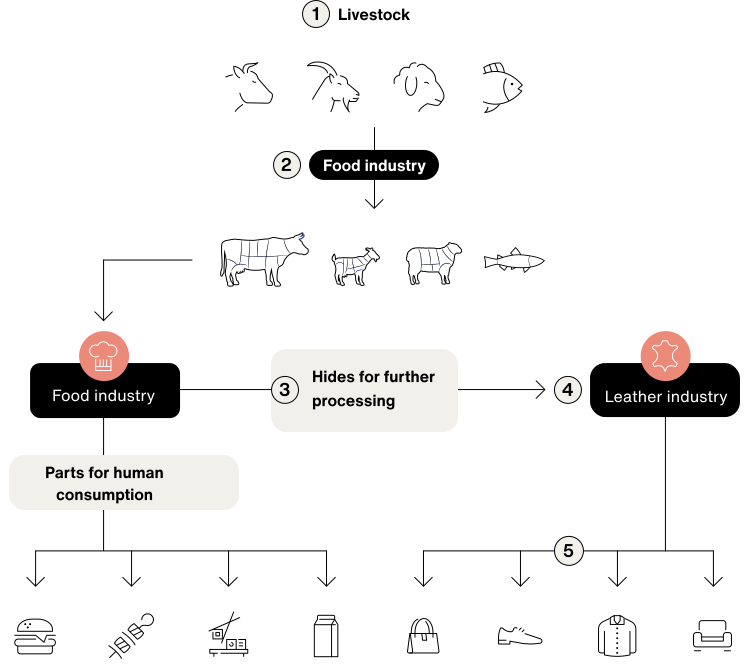
Livestock Farming to Consumer-Ready Product: The Lifecycle of Leather
- It all starts on farms where livestock is raised primarily for meat, milk, and wool.
- Post slaughterhouse, the potential of the fifth quarter is exploited (fifth quarter tissues are broadly split into two categories: edible co‑products (red offal: liver, heart, kidney, tail) and inedible byproducts (skin, bones, fat).
- Animal hides are then sold by slaughterhouses, either directly or to raw hide brokers, who in turn resell to tanners.
- The transformational process of tanning kicks off.
- Post tanning: when animal hides have been successfully converted into leather, leather manufacturing businesses purchase leather to produce various goods across different sectors, including leather goods, footwear, apparel, furniture, glove-making, saddlery and harness-making.
Exotic hides also exist. In regions of the world like Asia and Africa, animal meat from crocodiles, lizards, and pythons is a highly consumed delicacy. Their skin can equally be repurposed into leather. The protection of these species is regulated under The Convention on International Trade in Endangered Species of Wild Fauna and Flora (CITES). Most of these skins are individually traceable and comply with international standards for sourcing and livestock farming practices.
Without the tanning industry, hides would be treated as organic waste. which would have to be disposed of by incineration or landfilling, involving complex and highly polluting processes.
How Hides and Skins are Converted into Leather
The 3-layer anatomy of animal hide:

- The epidermis, the outermost layer of the skin, is thin and serves as a protective barrier for the underlying tissues while being exposed to environmental stressors.
- The dermis, which is the layer of living cells, organized into very dense connective tissues, which houses cutaneous nerve endings and where hair follicles form.
- The hypodermis is primarily comprised of fat and loose connective tissue which connects the skin to bones, muscles, and organs.

The Preservation of Hides and Skins (Curing)

Fresh hides undergo salting for preservation. Salting eliminates significant moisture present in the tissues, thereby slowing the growth of bacterial decay and rotting.
After 15 days, hides are inspected individually, sorted and graded according to their thickness, the number of flesh defects, the presence of scars, as well as their weight and surface area.
The River (Wet Work)
Upon arrival at the tannery, the hide undergoes “river work,” a 3-step process:

Soaking:
Rehydrate and clean raw skins to prepare for further treatment by removing unwanted residues.

Unhairing-Liming:
This process can be defined as the cleaning of the crude skin into refined form through a chemical unhairing process. It also removes epidermis and to some degree inter-fibrillary proteins and surface scales.

Fleshing:
Removing non-leather elements from a hide or skin, such as flesh and fat and connective tissue via mechanical fleshing devices.
Tanning

Tanning is the key operation to transform hide into leather. The hides used, mostly derived from the food industry, are perishable organic products. Tanning stabilizes the natural attributes of the hide, preventing its natural decomposition(rotting), and endows it with durability, flexibility, pliability and strength. Different types of tanning exist (mineral, vegetable, or synthetic), depending on the conversion agents used in the process.
Crusting/Finishing

The derived leather undergoes chemical and mechanical processing necessary to achieve its exquisite characteristics: chemical operations give the leather its color, pliability, feel and texture. During mechanical operations, its thickness is attributed via shaving procedures, then the dewatering action removes existing excess water, after the hide is wrung out and stretched which smooths out wrinkles and aligns the hide for uniform drying to follow.
Finishing

At this stage, leather develops its unique texture and appearance, ensuring consistency across production. Depending on its end use, leather can undergo the following finishes.
Selon les utilisations, on distingue les finissages suivants :

Aniline Leather:
Leather that has been dyed with aniline dye, which is transparent and allows the natural grain and texture of the leather to show through. It’s generally the most expensive and high-quality type of leather, possessing an authentic and natural look, with a soft and pleasant texture. But it’s also the most delicate and prone to staining and fading, requiring careful maintenance.

Semi-Aniline Leather:
Leather is coated with a layer of opaque pigment and translucent dyes that you see-through to protect it while still allowing the natural grain and texture of the leather to show through while smoothing out natural imperfections.

Pigmented Leather:
An opaque layer of pigment is applied to leather to completely cover its natural grain and texture. This coating also makes it more resistant to stains, fading and is easier to clean.
From raw hide to leather:
30 Steps over 4 weeks,
just 7 Minutes to master
the art of producing
exceptional leather!
(French spoken)